

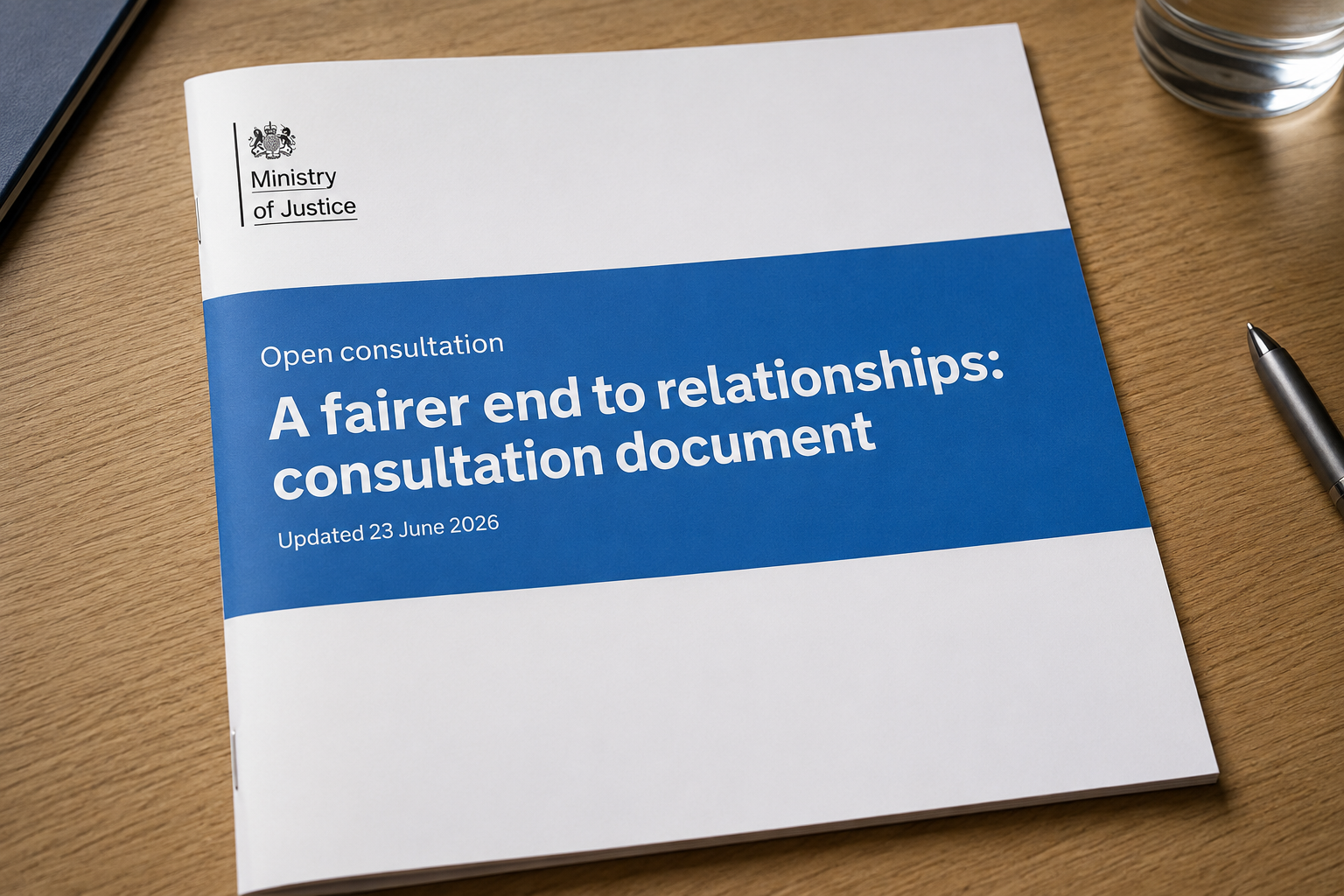
The Government has opened a wide-ranging consultation (running from 5 June to 14 August 2026) on reforming financial remedies on divorce and introducing long-anticipated rights for cohabiting couples. This article investigates what these reforms are and how they could affect individuals navigating a relationship breakdown.
Financial remedy proceedings
A central feature of the consultation is the introduction of a more structured statutory framework for financial remedies. This would formalise the existing principles of needs and sharing, whilst providing a more structured and predictable framework for couples resolving their financial arrangements upon separation.
The Government proposes a three-stage approach under which children’s needs are given clear priority. This is closely followed by an assessment of the financial needs of each spouse, including housing, income, and pensions. Only once those needs have been addressed would the court consider any discretionary or “lifestyle” needs either party might have, and even then, only where sufficient resources are available.
Importantly, the starting point remains equal sharing of matrimonial assets, unless a different division is required to meet needs.
Qualifying nuptial agreements (QNAs)
The consultation introduces the concept of legally binding nuptial agreements. To be enforceable, agreements would need to incorporate a number of key safeguards, including:
Where a QNA is challenged, the court would focus narrowly on whether essential needs are met, rather than wider discretionary or “lifestyle” needs.
Cohabitation
A significant development is the proposed introduction of a statutory framework for cohabitants, marking a departure from the current limited legal protections.
Eligibility may apply to couples who:
The framework would be needs-based, not sharing-based, meaning individuals would generally retain what they own unless redistribution is necessary to meet defined needs. Awards would be more limited than on divorce, ensuring marriage retains a distinct legal status.
The emphasis remains on:
This focus on clean breaks reflects a broader policy trend towards encouraging financial independence post-separation.
The consultation also proposes extending intestacy rights to qualifying cohabitants, allowing them to inherit automatically where a partner dies without a will. This would align inheritance rights more closely with modern family structures and provide greater financial security.
Domestic abuse
Across both divorce and cohabitation frameworks, the Government is considering greater recognition of domestic abuse, including coercive or economic control, when determining financial outcomes.
In particular, the consultation suggests that courts may be given clearer statutory permission to take account of how abuse has affected a party’s financial position, earning capacity, or ability to make autonomous decisions during the relationship and after separation.
At present, while the court can take conduct (including abuse) into account, the threshold is high and rarely applied in financial cases. These proposals signal a potential shift towards more meaningful and consistent consideration of abuse in financial proceedings.
The reforms may also strengthen the link between abuse and “needs” by recognising that victims of domestic abuse often require greater financial provision to secure safe housing, additional support due to disrupted employment or health impacts or protection from continued economic control post-separation.
What this means going forward
These proposals aim to modernise family law in line with contemporary relationships while promoting fairness and autonomy as well strengthening protections for cohabitants and vulnerable individuals more generally.
The consultation represents a significant opportunity to reshape the legal landscape for family relationships in England and Wales. It is likely to generate considerable interest and debate across the legal sector in the months ahead.
"Sinclair Gibson’s team has the self-belief and the ability to make the bold, difficult advisory decisions others would shy away from. It has a very good team culture, work ethic and consistent delivery."
Chambers HNW 2025