

The Office for National Statistics (ONS) has recently published its latest report on divorce and dissolution of marriages in England and Wales, providing an interesting insight into how modern relationships are evolving and the continuing impact of the no-fault divorce regime.
The figures show that there were 105,002 divorces in 2025. While these numbers are broadly consistent with 2023 and 2024, they remain significantly lower than the annual highs seen during the 1980s, 1990s and early 2000s, when around 150,000 divorces were recorded each year.
No-Fault Divorce Continues to Dominate
One of the most notable findings is the continued uptake of the no-fault divorce process introduced by the Divorce, Dissolution and Separation Act 2020.
In 2025, 94.2% of all divorces and dissolutions were granted under this 2020 legislation, which only came into effect in April 2022, with 74.1% proceeding as sole applications and 25.9% as joint applications. The remainder will be old law cases that were filed before the new process came into force.
Divorce Rates Remain Stable
The ONS reports that the divorce rate for opposite-sex couples was 8.4 divorces per 1,000 of married people in 2025, broadly unchanged from recent years and substantially below the peak of 14.2 per 1,000 recorded in 1993.
For same-sex marriages, the divorce rate was 19.5 per 1,000 of married people, a figure that has begun to stabilise following increases seen between 2015 and 2021.
Marriages Are Lasting Longer Before Divorce
Another significant trend is that marriages are lasting longer before ending in divorce.
The median duration of an opposite-sex marriage ending in divorce reached 13 years in 2025, the longest recorded since the ONS began collecting comparable data in 1963.
This continues a long-term trend of couples remaining married for longer before separating and divorcing. The ONS also found record-high durations for same-sex civil partnerships, with median partnership lengths exceeding 13 years before dissolution.
Fewer Recent Marriage Cohorts Ending in Divorce
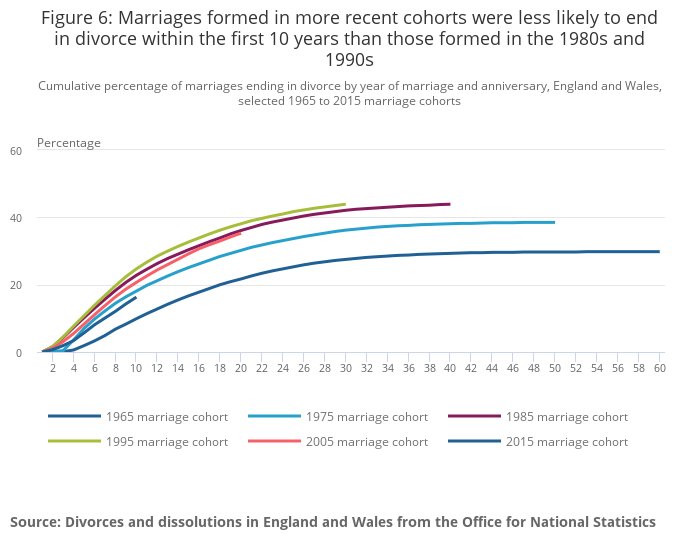
The report highlights an encouraging long-term trend. Of couples who married in 2015, an estimated 16.3% had divorced before their 10th wedding anniversary. This compares with 24.7% of couples who married in 1995, indicating that more recent marriage cohorts appear less likely to divorce within the first decade of marriage.
What Does This Mean for Separating Couples?
While divorce numbers have remained relatively stable, the data demonstrates how the landscape of relationship breakdown continues to evolve. The introduction of no-fault divorce and the increasing length of marriages before separation suggest that couples are approaching relationships and relationship breakdown differently from previous generations.
The figures may also reflect a broader trend towards proactive relationship planning. The increasing popularity of pre-nuptial and post-nuptial agreements means that many couples are having open discussions about finances, expectations and long-term objectives before entering into marriage or during the marriage itself. In many cases, these conversations encourage greater transparency and help couples address potential areas of disagreement at an earlier stage.
Obtaining specialist legal advice is therefore no longer just something to consider when a relationship has broken down. Early advice can help couples understand their respective positions, manage expectations and put in place arrangements that provide clarity and reduce the scope for future disputes. Whilst no single factor explains long-term divorce trends, this shift towards early planning and informed decision-making may be contributing to lower divorce rates among more recent marriage cohorts.
Where a relationship does break down, obtaining specialist legal advice at an early stage can help separating couples understand their options regarding finances, property, pensions and arrangements for children.
The Family Team at Sinclair Gibson advises clients on all aspects of divorce, financial remedy proceedings, private FDRs, arbitration, children matters as well as nuptial and cohabitation agreements. If you would like advice regarding anything mentioned in this article, please contact a member of our team.
"Sinclair Gibson’s team has the self-belief and the ability to make the bold, difficult advisory decisions others would shy away from. It has a very good team culture, work ethic and consistent delivery."
Chambers HNW 2025